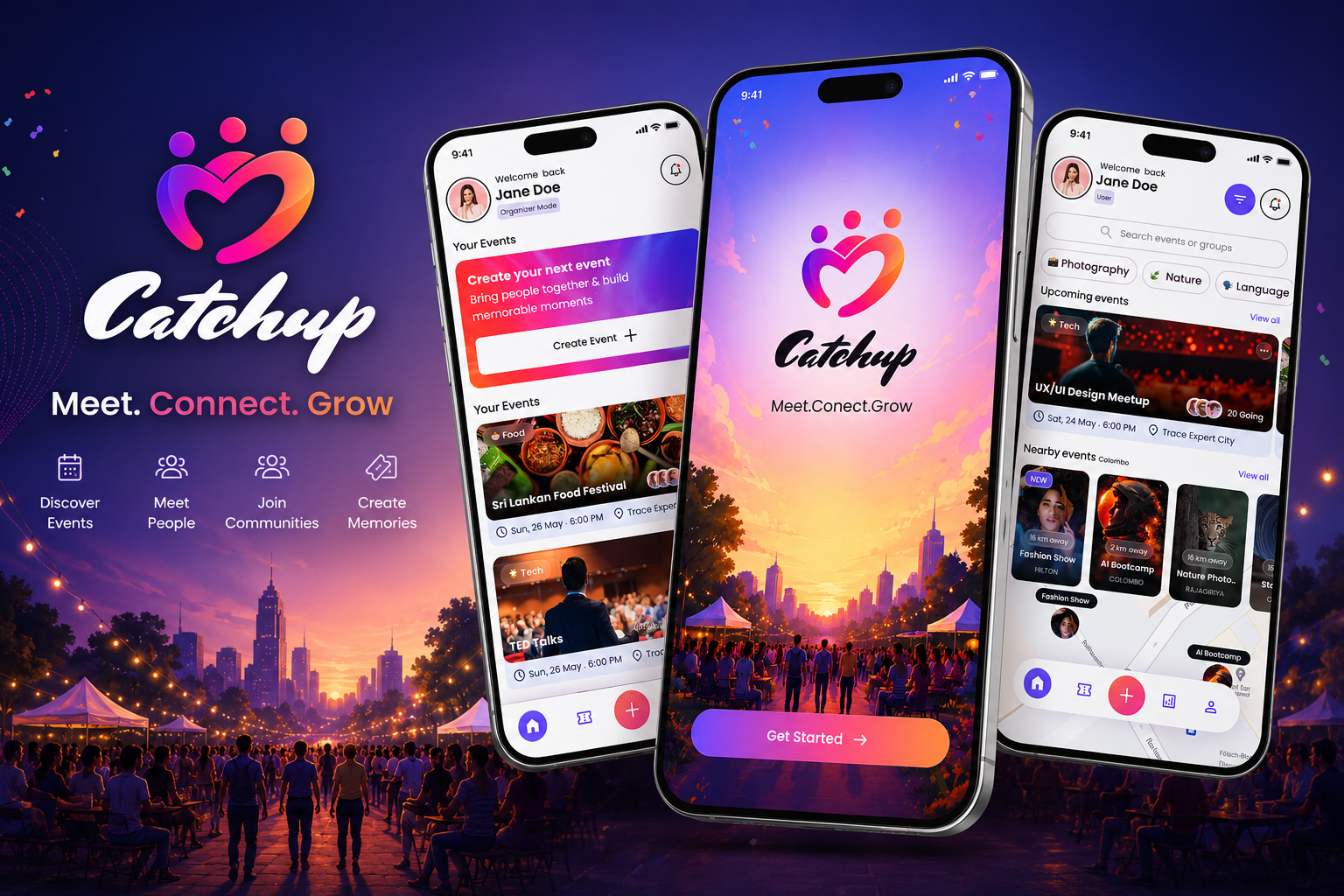
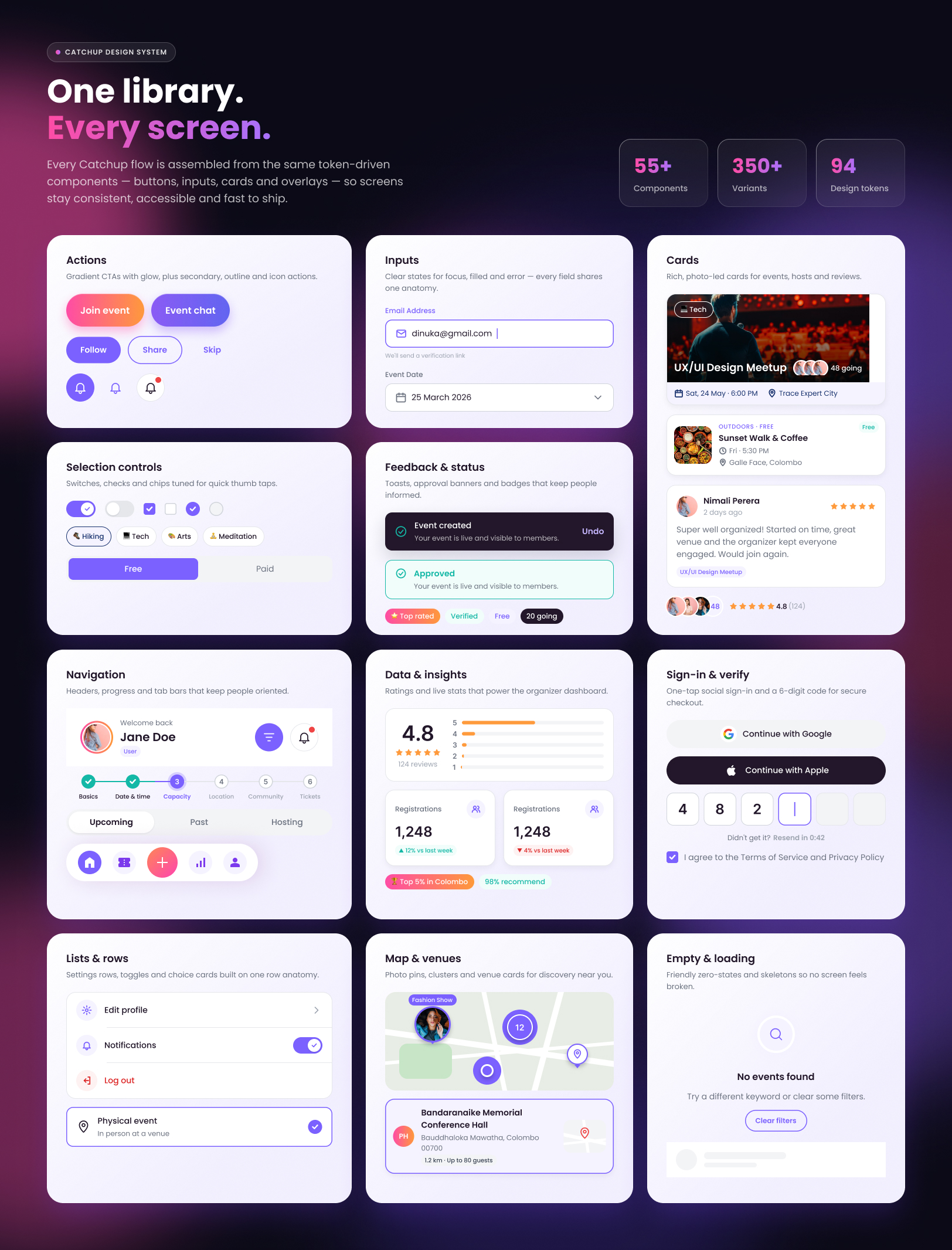
A Sri Lankan-first alternative to Meetup — combining communities, activities and events into one local discovery platform, taken from a broad client brief to a defined product direction, architecture and design plan.
Role
Lead UX & UI Designer (solo)
Status
Concept · UX Case Study
Focus
Strategy · Research · IA
Market
Sri Lanka
01 — The Story
Finding Your People Shouldn't Depend on Who Has Your Number
When I moved to a new city, I wanted to meet people who liked the same things I did: running, reading, building things.
In Sri Lanka, that usually means waiting for someone to add you to a WhatsApp group, or finding a Facebook post by luck.
The events are out there. Discovery is the problem. And going alone to an event run by a stranger feels risky.
So Catchup had two jobs: make events easy to discover, and make people feel safe enough to show up.
How might we create a local community and activity platform that makes it easier for Sri Lankan people to discover, join and organize meaningful experiences?
02 — Project Overview
Four Roles, One Ecosystem
Catchup is a Sri Lanka-first platform for discovering and organising community events. Think Meetup, localised for how people here actually live.
I led the UX and UI end to end, solo, in two weeks: from domain research to a high-fidelity design across four user roles.
The client chose a free-first strategy: no event fees for the first two to three years, adoption before revenue. That one decision shaped the whole product. Catchup is designed for four roles and launches with three. Venue owners join in Phase 2.
Attendees
Discover and participate in communities and events
Find interesting activities, join communities, and attend events.
Organizers
Create communities and organize events
Build your community, create events and manage attendees with easy tools.
Venue Owners
Provide spaces for events
List your venue, manage bookings and connect with organizers.
Admins
Manage approvals, moderation and platform safety
Keep the platform safe and trustworthy for everyone.
The initial product focuses on communities, events, classes, bootcamps, sports, hiking, health and wellness, IT communities, local event discovery and local payment options. A future trip-planning experience was considered but intentionally kept outside the MVP scope.
End-to-end UX research, strategy, information architecture and UI design.
Timeline
Two weeks
From brief to high-fidelity design using an AI-assisted workflow.
Type
Concept project, developed from a client brief
A Sri Lankan-first community and event platform.
Tools
Google StitchLow-fidelity exploration
Claude + Figma MCPScreen generation
FigmaDesign system & prototype
FigJamFlows & IA
ChatGPTVisual reference
An AI-assisted workflow let me move from brief to high-fidelity design in two weeks.
03 — The Challenge
Three Problems Under One Product
The hard part wasn't designing an events app. It was solving three problems underneath it.
Revenue. With a free-first model, the platform couldn't earn from tickets. It needed another business model.
Trust. Catchup asks strangers to meet strangers. People won't show up unless the product signals it's safe.
Four roles. Attendees, organisers, venue owners and admins each have different goals. One product had to serve all of them without feeling like four apps.
The question I kept coming back to: what makes someone comfortable enough to show up alone?
04 — Domain Analysis
Starting With The Domain, Not The Screens
Before designing screens, I mapped the domain Catchup would operate in. I reviewed how Meetup works, how community events in Sri Lanka are promoted and booked today, how Koko fits into local payments, and worked through the brief in conversations with the client.
Mapping these areas together changed how I saw the product. Catchup isn't an event-ticketing app. It's a local community platform, where events are one outcome.
Organisers have no record, and venue owners have no booking pipeline.
03
Koko is already trusted.
It's a local BNPL (buy now, pay later) service people use every day.
Each insight became a product decision: free events by default, a venue booking flow, and Koko at checkout for paid events.
05 — Gap Analysis
What the Brief Was Missing
The client's brief was "Meetup, localised," with a free-first strategy for the first two to three years.
My research found two gaps in that brief.
1
Payment flexibility.
Some events are paid, and not every attendee can pay upfront. I proposed Koko instalments alongside standard bank payments.
2
A revenue stream.
Venue bookings happen over WhatsApp with no system. A venue booking flow with commission earns revenue without charging organisers or attendees.
Koko made the MVP, since upfront payment was a core attendee pain point. Venue booking is designed and planned for Phase 2, once enough organisers are on the platform to make venues worth listing.
O1
Local experience. Design around Sri Lankan locations, communities, activities and user behavior.
O2
Payment accessibility. Explore local payment options and installment payments for eligible paid experiences.
O3
Activities, not just events. Support ongoing interests — learning, sports, hiking, fitness, bootcamps and classes.
O4
Organizer + venue ecosystem. Help organizers discover suitable venues and create a business opportunity for venue owners.
O5
Trust & safety. Build stronger local governance around community and event creation.
Found in analysis · O2Installment payments with Koko
The brief
The client had not considered installment payments. Paid events were planned as a single upfront payment.
After analysis
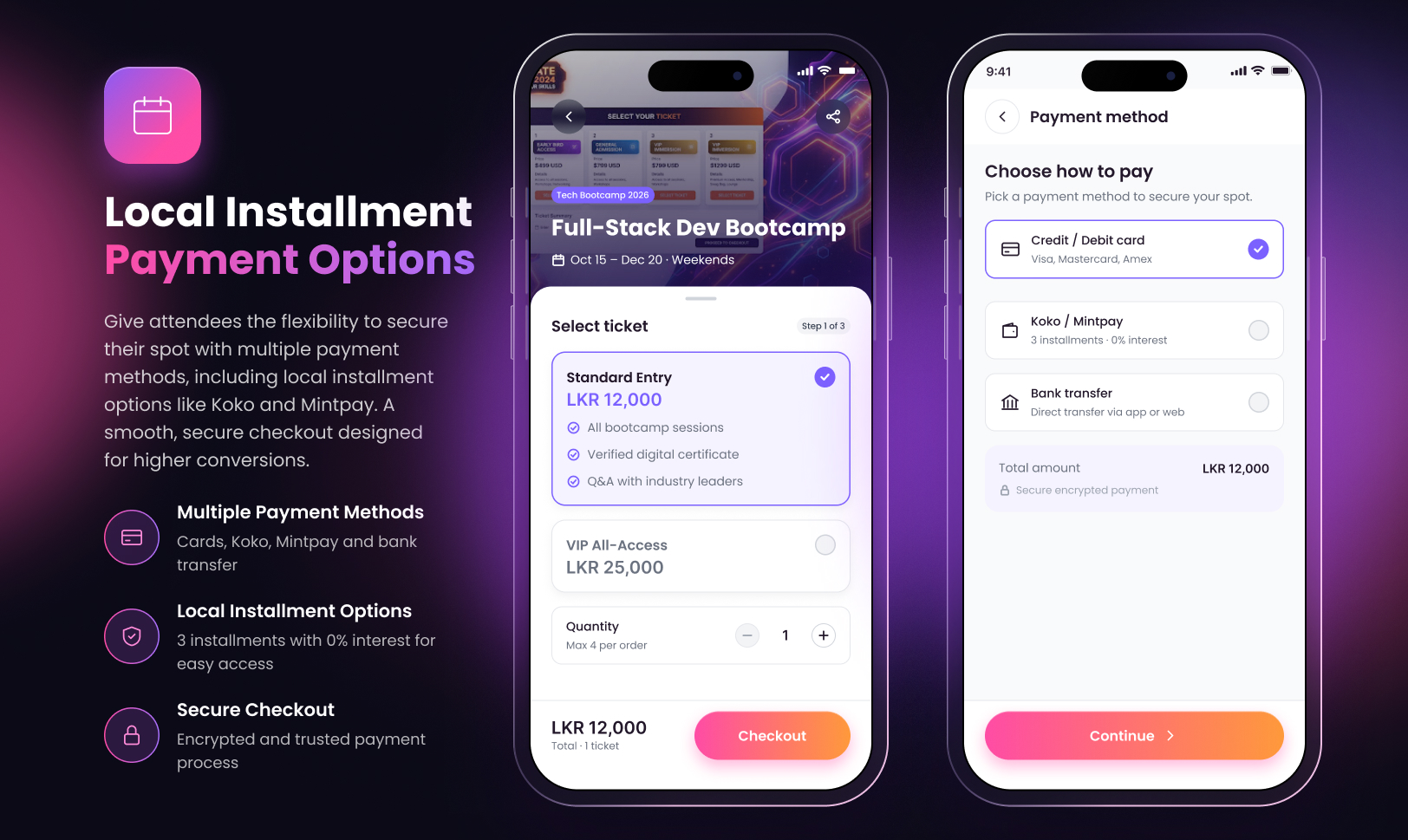
Gap analysis pointed to Koko, a local buy-now-pay-later app, as a way to split the cost of paid experiences. I proposed it to the client as a checkout option for eligible paid events.
Found in analysis · O4Commission on venue bookings
Connecting organizers with venues also opened an earning opportunity for the platform: Catchup takes a commission on each venue booking made through it. This gives the business a revenue stream that does not depend on attendees paying for events, many of which are free.
Found in analysis · Future phaseTrips
Trips came out of the analysis as the option with the highest revenue potential. I presented it to the client, and it was kept out of this phase as a candidate for a later release.
Assumptions To Validate
Would installment payments increase participation?
How important are local payment methods?
Do organizers struggle to find suitable venues?
Do users prefer communities over individual events?
What makes a Sri Lankan community feel trustworthy?
06 — Personas
Four Roles, Four Sets Of Needs
These are proto-personas, built from domain research and client conversations, not user interviews. They're working hypotheses to validate through testing.
Nadeesha
Attendee · “The Cautious Joiner”
Age27
OccupationMarketing Executive
LocationColombo
Tech comfortHigh
“
I want to meet new people and try new things, but I'm not handing over money to a stranger's WhatsApp group for an event I know nothing about.
Goals
Discover things to do outside work and existing friend groups — hiking, fitness, learning something new.
Try an activity without financial risk before committing money.
Find organizers and events she can trust are legitimate and well-run.
Pain Points
No reliable way to judge if an organizer or event is trustworthy before showing up.
Payment upfront for an unknown event feels risky — no refund clarity, no track record.
Relies on scattered Facebook/WhatsApp groups with no structure, ratings, or filtering.
Limited free time — doesn't want to dig through irrelevant listings.
Needs
Free events to try first, with paid options clearly marked and reasonably priced.
Visible organizer ratings and reviews before she joins.
Simple search and filter by category, location, date, and price.
A map view to see what's happening nearby without much effort.
Dinal
Organizer · “The Side-Hustle Leader”
Age34
OccupationFreelance fitness coach — weekend hiking trips and bootcamp classes
LocationKandy
Tech comfortMedium
“
I've built a solid group of regulars, but growing beyond word-of-mouth means looking more professional than a WhatsApp group admin — and I need people to trust me before they'll show up.
Goals
Grow his attendee base beyond his existing circle.
Be seen as a credible, professional organizer, not just a hobbyist.
Spend less time on admin and more time actually running events.
Pain Points
No way to demonstrate a track record to new, unfamiliar attendees.
Finding a decent, affordable venue involves a lot of manual searching and calling around.
Tracking who has paid, confirmed or is waitlisted across WhatsApp is error-prone.
No visibility into which events are actually working.
Needs
A public profile with ratings and reviews to build credibility over time.
Venue suggestions when setting up a physical event.
A simple dashboard showing attendance and basic performance per event.
An easy way to run free events immediately, with paid events layered in later.
Ruwani
Venue Owner · “The Underused Space Owner”
Age45
OccupationOwns a small community hall / event space
LocationGalle
Tech comfortLow–medium
“
My hall sits empty most weekday evenings. I just don't have a way to reach the kind of people who'd actually want to book it.
Goals
Fill unbooked time slots with paying organizers instead of occasional word-of-mouth bookings.
Earn extra, fairly passive income from a space she already owns.
Keep the booking process simple — she has no time for a complex system.
Pain Points
No visibility to organizers who are actively looking for a venue like hers.
Handles all inquiries and bookings manually by phone — slow and easy to lose track of.
Uncertain how commission and fees work, and wary of anything opaque.
Needs
A straightforward venue profile — photos, capacity, pricing, availability.
Clear, simple booking requests she can accept or decline.
A dashboard that plainly shows bookings, earnings, and Catchup’s commission.
Chamith
Admin · “The Trust & Safety Gatekeeper”
Age30
OccupationOperations / Trust & Safety at Catchup
LocationColombo
Tech comfortHigh
“
One bad actor slipping through and organizing something harmful could undo all the trust we're trying to build. I need to catch problems early, without becoming the bottleneck.
Goals
Keep the platform safe from fraudulent or harmful groups and events.
Catch problematic activity early, before it reaches attendees.
Scale moderation as the platform grows, without reviewing everything manually forever.
Pain Points
At launch, every group and event needs manual review — this does not scale.
No easy way to prioritise what is genuinely risky versus routine approvals.
Limited signals early on — new organizers have no history to evaluate against.
Needs
A centralised approval queue for new organizers, groups and flagged events.
Clear alerts for reported content, prioritised by severity.
The ability to quickly suspend or remove a group, event or user.
Nadeesha won't join a stranger's event without a trust signal.
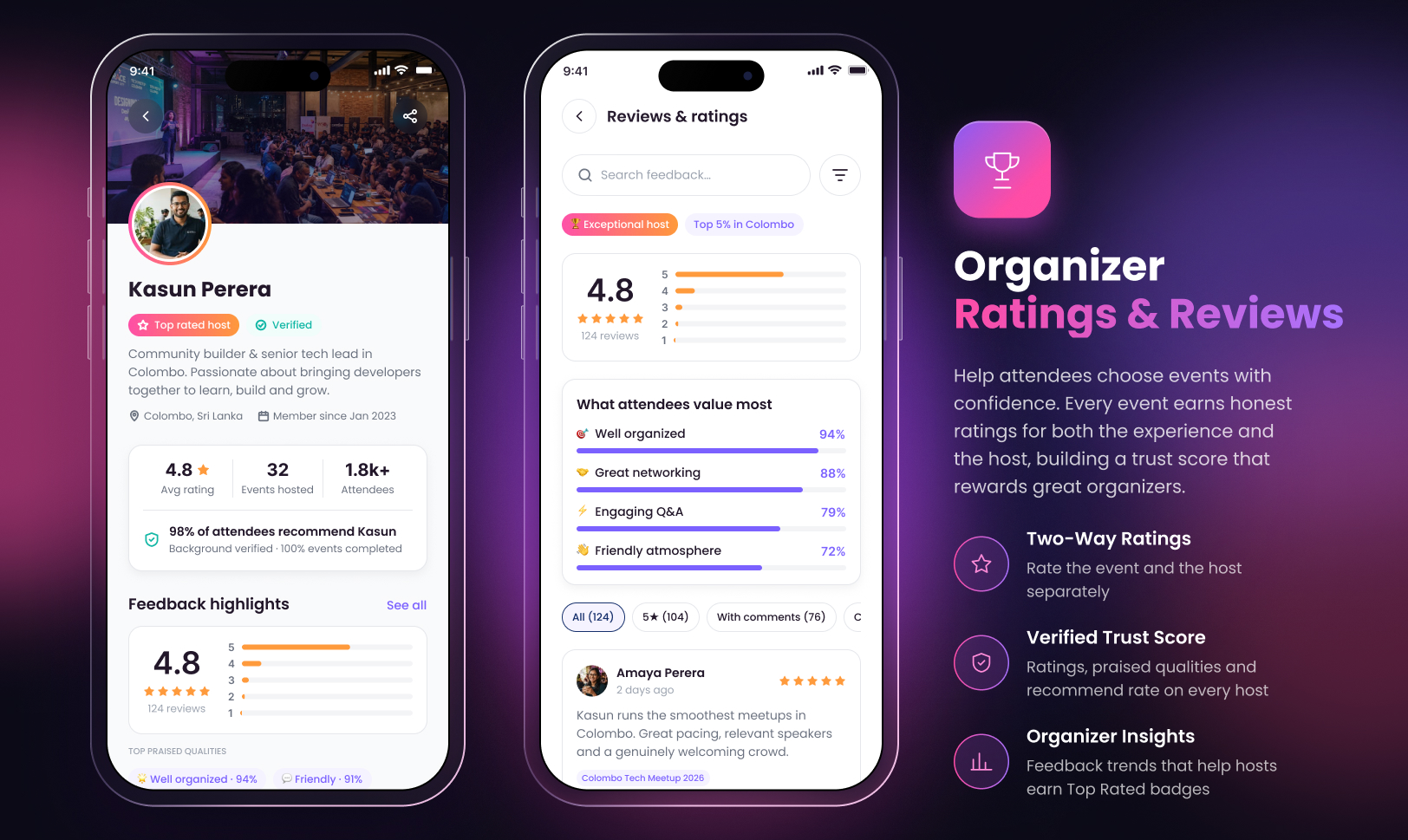
Organisers show ratings from past attendees.
Dinal spends more time chasing attendees than coaching.
Organisers get messaging and attendee management tools.
Ruwani's hall sits empty because only people with her number can book it.
Venues get a discoverable, bookable profile (Phase 2).
Chamith needs to catch bad actors early.
Moderation is a built-in admin role, not an afterthought.
07 — Problems To Solve
From Pain Points To Problem Statements
Each problem statement maps to a specific part of the product, grouped into three themes.
Help people discover communities and activities they care about, make participation easier, and give organizers the tools to build and manage those experiences.
Supporting that core direction: local payments to make participation more accessible, venue connections to help organizers find suitable spaces, and trust & safety to make the ecosystem safer.
Discovery and reach
1Attendee
Discovery is fragmented, with no single place to find communities
Category browsing, search, and nearby events on a map
7Venue owner
No way to reach organisers looking for space
My addition
Bookable venue profiles and a booking flow, with commission as revenue
Trust and payment
2Attendee
Needs confidence in an organiser before joining or paying
Organiser rating and past events shown on the event page
5Attendee
Upfront payment is a barrier for paid events
My addition
Koko instalments alongside standard bank payment
6Admin
An open platform needs approval and moderation
Organiser approval and a moderation queue for reports
Operational effort
3Organiser
Needs to run free events from day one
Free RSVP, one-tap join with no payment setup
4Organiser
Managing attendees, payments and communication is complex
Organiser dashboard with attendee management and messaging
8Organiser
No visibility into event performance
Event analytics (post-launch)
Prioritised by impact against build effort
Ratings, free events, moderation and Koko shipped first. Each removes a launch blocker: trust, access, safety and cost. Venue booking is high impact but depends on organisers already being active, so it moved to Phase 2. Trips was deferred entirely: high effort with unproven demand. The matrix is why the MVP launches with three roles instead of four.
User impact →
Do first · MVP
Plan · Phase 2
Quick wins
Defer
1234a4b5678
Build effort →
MVP scopePhase 2Later
1
AttendeeDiscovery is fragmented — no single place to find relevant communities and activities.
2
AttendeeAttendees need confidence in an organizer before they join or pay.
3
OrganizerRunning free events must be possible from day one, with no payment setup.
4a
OrganizerA basic attendee list to see who's coming.
5
AttendeeUpfront payment is a barrier — local payment methods are needed.
6
AdminAn open platform needs approval and moderation to stay trustworthy.
4b
OrganizerFull attendee tools: waitlist, check-in and messaging.
7
Venue OwnerVenue owners have no way to reach organizers actively looking for space.
8
OrganizerOrganizers need visibility into event performance over time.
I placed each problem statement on an impact vs. effort matrix, and it drove the key scope calls.
Organiser trust (#2) was solved first with ratings. High impact, low effort.
Venue reach (#7) was solved with a venue booking flow. High impact and more effort, but worth it because it's also the platform's revenue stream.
Trips never made it onto the MVP matrix. High effort and unproven demand, so it was deferred.
The matrix kept the MVP focused on what the platform needs to launch.
08 — Feature Map
MVP and What Comes Later
Not every feature could ship at once, so I split scope into MVP and post-launch.
MVP: everything the platform needs on day one.
Attendees
Discover and join events
Organisers
Create events and manage attendees
Venue owners
List and manage their space
Admins
Moderate content and users
Post-launch: Trips, recurring events, and deeper venue analytics.
The priority matrix set the line, not personal preference.
Catchup
Attendee
Discover
Explore & search
Category & price filters
Nearby events + map
Recommended for you
Participate
Group & event pages
Join group / RSVP
Checkout for paid events
Koko instalments
Account
My Activity
Notifications
Reviews & ratings
Organizer
Onboarding
Organizer application
Public organizer profile
Build
Create group
Create event (free)
Create event (paid)
Recurring events
Trips
Operate
Manage attendees
Waitlist & confirmations
Event dashboard & analytics
Venue discovery & requests
Venue Owner
Listing
Venue registration
Profile: photos, capacity, pricing
Availability calendar
Bookings
Booking requests
Accept / decline
Upcoming bookings
Insight
Earnings & commission
Venue analytics
Admin
Approvals
Organizer approvals
Group / event review queue
Moderation
Reports & alerts
Suspend or remove
Management
Users & groups
Events & venues
MVP scopePost-launch
Free-first, with paid events from day one. Most events are free, and paid ones offer Koko instalments so upfront cost isn't a barrier. The venue owner role is fully designed and launches in Phase 2.
09 — Information Architecture
Organized Around Discovery & Participation
The main attendee experience was structured around two jobs — finding something worth doing, and keeping track of what you've joined. Organizer, venue owner and admin experiences become role-specific workspaces rather than separate products. The venue owner workspace is fully structured but launches in Phase 2.
Attendee
Home
Discover
Event detail
Join & pay
My events
Profile
Organiser
Dashboard
Create event
Manage attendees
Venue booking
Payouts
Venue owner
Venue profile
Availability
Booking requests
Earnings
Admin
Moderation queue
Reports
User management
Shared
AuthNotificationsSettingsRole switcher
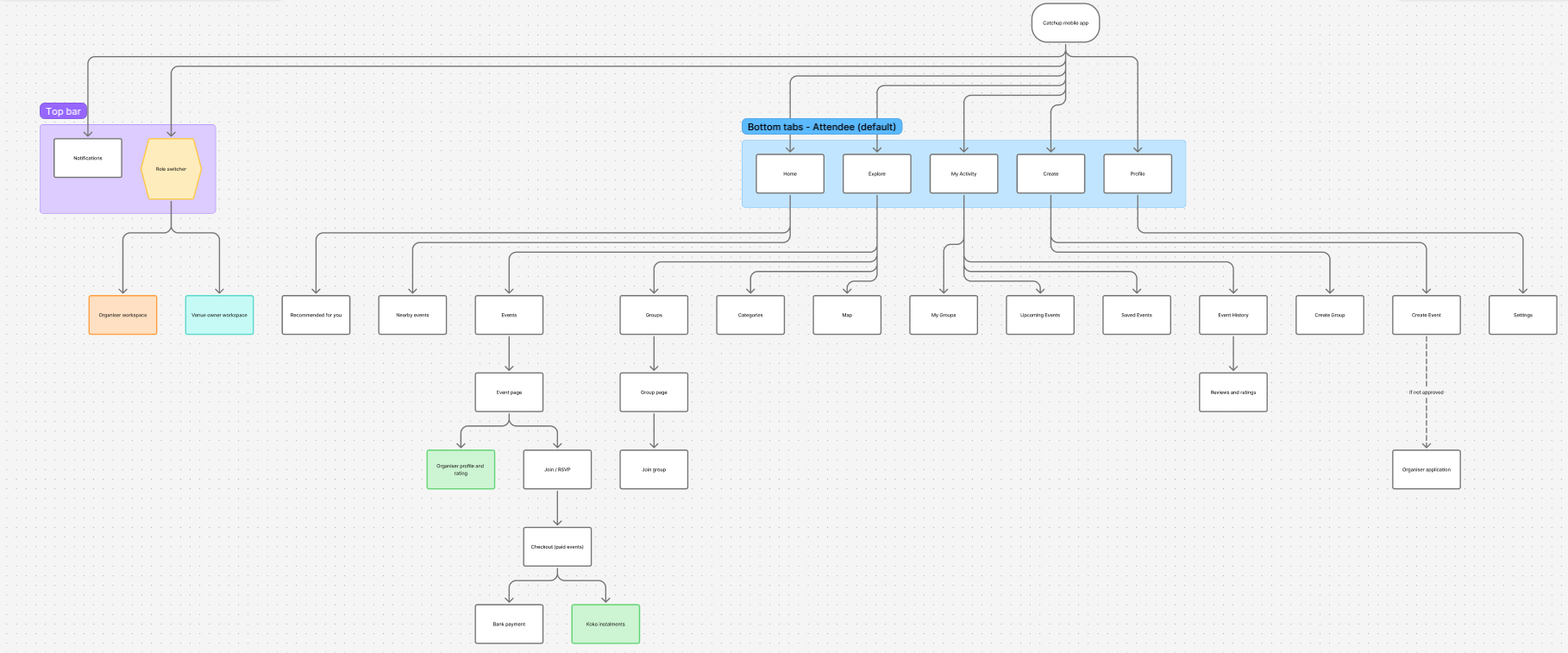
Detailed architectureAttendee app mapped in FigJam, down to checkout and the role switcher.
Click to open full size
One account, many roles.
A user can attend and organise. Instead of separate accounts, a role switcher changes the view. This was the trickiest structural decision.
Shallow join flow.
Three taps from opening the app to joining an event.
Progressive disclosure.
Payouts and earnings only appear once money actually moves.
The full working board — personas, problem-to-solution map, information architecture and priority matrix:
10 — Key User Journeys
Eight Journeys Across Four Roles
Each journey below expands into the step sequence that shaped the flows:
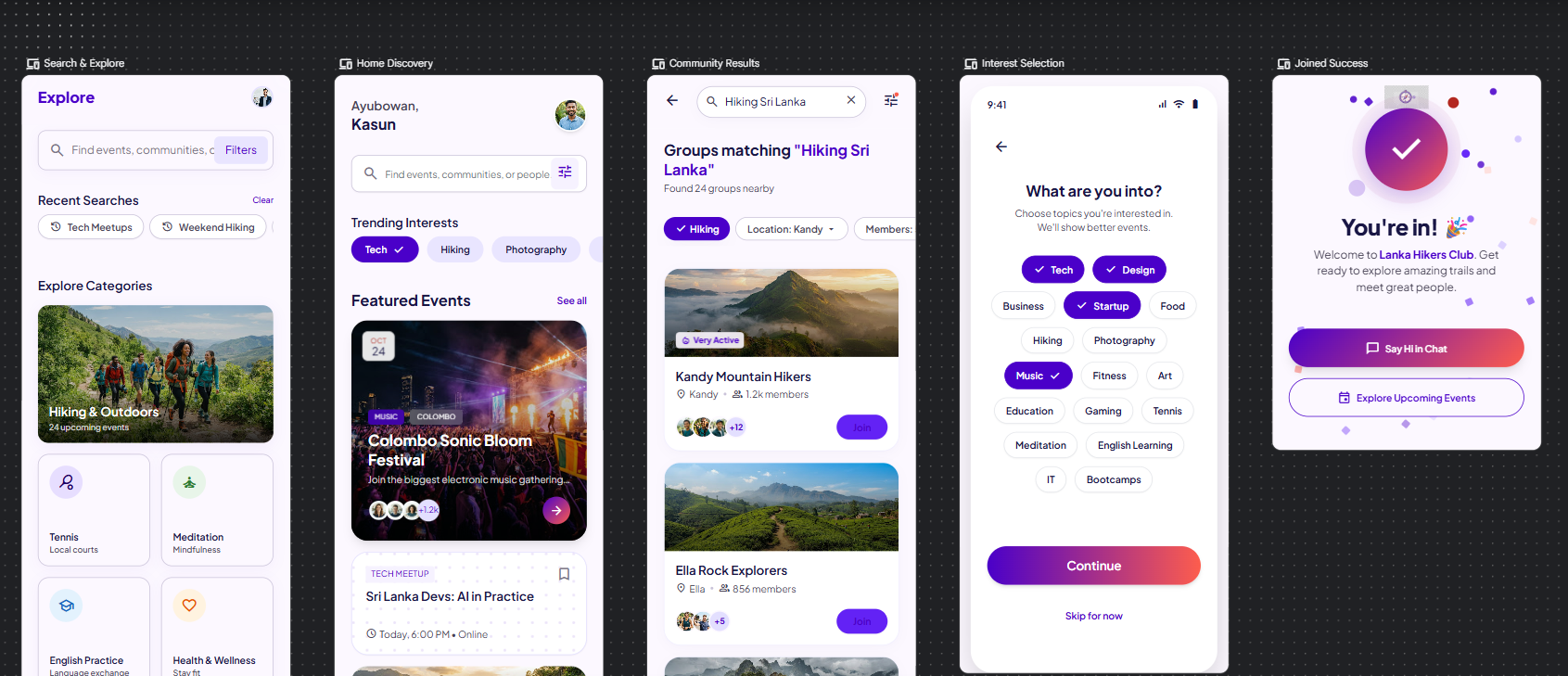
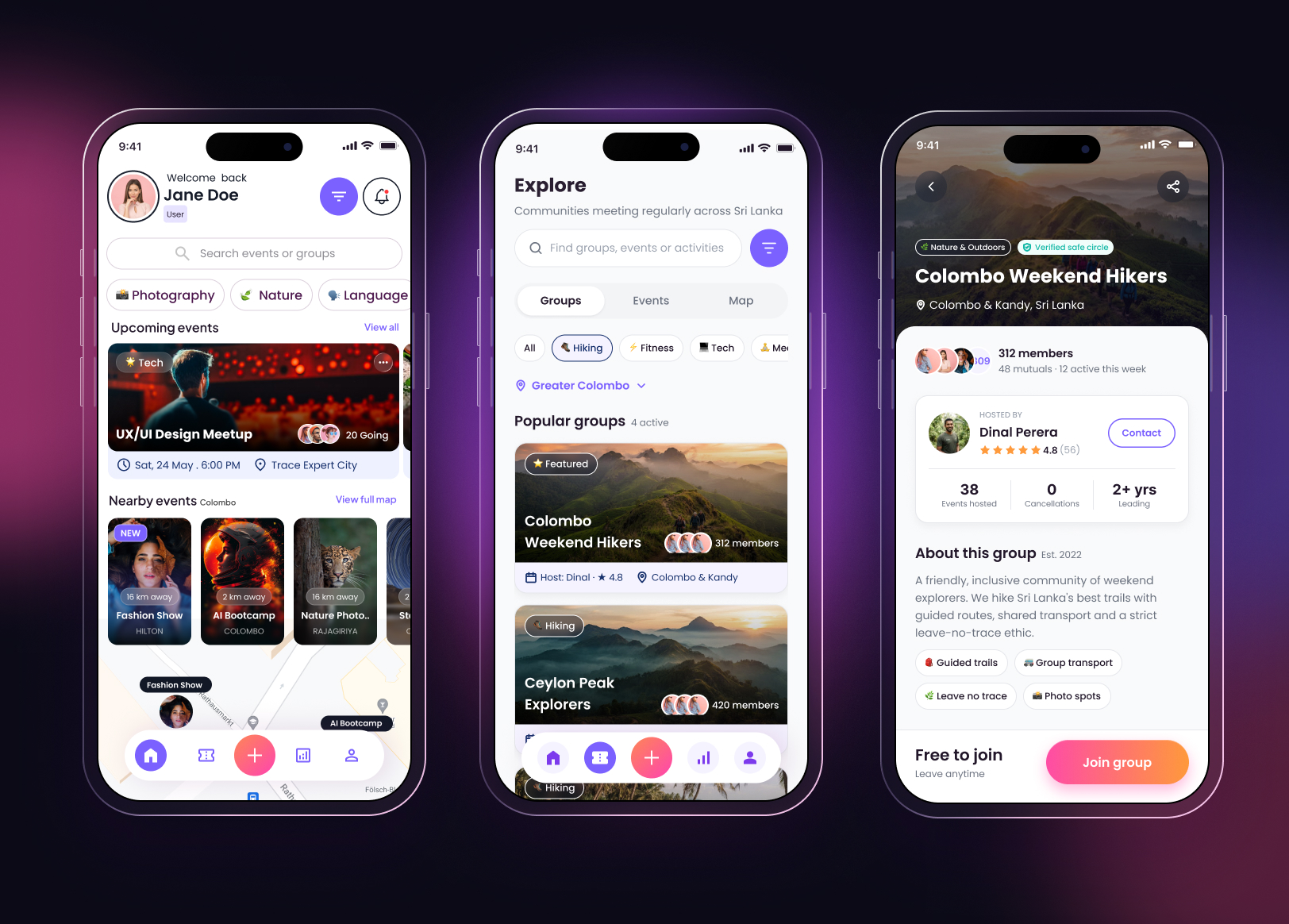
Home → Explore → Group results → Group details → Join group → Group events.
Home → Explore events → Search / filter → Event details → RSVP → Confirmation → My Events.
Event details → Checkout → Payment options → Full payment or installments → Confirmation → Event ticket.
Profile → Become organizer → Application → Admin approval → Organizer dashboard → Create group → Create event → Publish.
The wireframe stage focused on validating structure and interaction before any visual polish. The first set covered eight screens:
Attendee
Discovery
Group details
Event details
Paid event / checkout
Organizer & Admin
Organizer dashboard
Event management
Venue discovery
Admin dashboard
Logo slot
Tooling · Google StitchI did wireframe with Google Stitch. I found it was easier to generate and ideate the full user flow with Google Stitch, so I have done low fidelity UIs and skipped wireframes. Instead of wireframing I generated low fidelity UI flows.
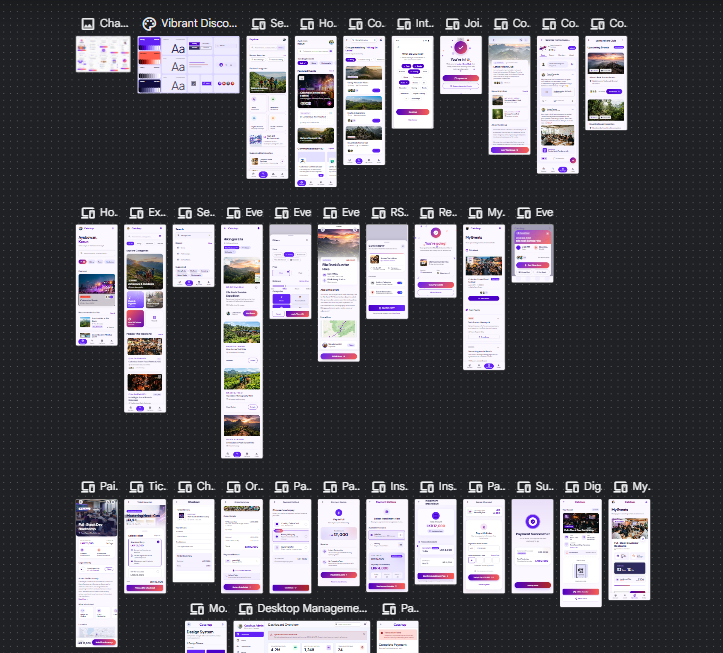
Full boardEvery screen laid out by flow — attendee discovery and joining across the top, event and booking flows in the middle, payments, tickets and admin below.
Core flowThe attendee path in detail: search and explore, home discovery, community results, interest selection, and the joined confirmation.
12 — UI Design
Translating Structure Into Interface
The visual design translates the validated structure into a clear, accessible and scalable interface — built to carry four different role experiences without becoming four different products.
Clarity
Clear hierarchy
Accessible typography
Clear event information
Discovery
Strong search and discovery
Category-led browsing
Trust
Trustworthy payment experience
Visible community signals
Scale
Consistent components
Role-specific dashboards
Responsive layouts
13 — Prototype
Connecting The Critical Journeys
The high-fidelity prototype connects the journeys that carry the most product risk — discovery, payment, creation and governance:
Discover a groupJoin a groupDiscover an eventRSVPPay for an eventInstallment paymentCreate an eventManage attendeesFind a venueAdmin approval
The prototype in motion — moving through discovery, the event page and the join flow:
Demo — enrol in a paid event
Recorded on device: event details, checkout, and payment with Koko instalments.
14 — Usability Testing
What The Prototype Needs To Prove
The prototype is designed to be tested with representative users from each role. These are the questions each test needs to answer:
Test Questions By Role
Attendee
Can users find a relevant group quickly? Do they understand the difference between groups and events? Can they read event information? Do they trust the payment flow and understand installments?
Organizer
Can an organizer create a group and event? Can they manage attendees, understand event analytics, and find a suitable venue?
Venue Owner & Admin
Can a venue owner understand a booking request, manage availability, and accept or reject an opportunity? Can admins process approvals quickly, identify problematic content, and take the correct moderation action?
15 — Design Principles
Five Rules That Settled The Arguments
P1
Community before transaction. Catchup should not feel like a ticket marketplace. Interest → community → activity → event → participation.
P2
Local first. The experience should reflect Sri Lankan users, locations, activities and payment behavior.
P3
One user can have multiple roles. An attendee can become an organizer — capabilities expand rather than forcing users into separate products.
P4
Trust is part of the product. Moderation and organizer approval directly influence whether people feel comfortable participating.
P5
Don't overbuild the future. Trips were intentionally kept outside the MVP.
16 — Expected Impact & Takeaway
How Success Would Be Measured
This is a concept case study — the measures below are the ones the product should be judged on once built and tested, not results already achieved.
Discovery
Group discovery rate
Group join rate
Event RSVP conversion
Payments
Paid event conversion
Payment completion
Installment adoption
Supply
Organizer activation
Event creation rate
Venue booking conversion
Retention
Repeat participation
Community engagement
Final Takeaway
Catchup started as an idea for a local version of Meetup. Through the early UX process the opportunity became broader — value for attendees through discovery and participation, for organizers through community and event management, for venue owners through new booking opportunities, and for admins through governance and trust. Venue booking went to Phase 2. It's the revenue engine, but it only works once organisers are active. Launching it too early would have meant empty listings.
The strongest opportunity is not copying Meetup feature-for-feature. It is creating a Sri Lankan-first ecosystem around meeting people, learning, participating and doing things together.